
How to Add Different CC and BCC Recipients in Mail Merge
With Mail Merge, you can easily add CC and BCC recipients to your email campaigns and they’ll receive a copy of every email that goes out to your merge recipients.
Using CC and BCC in Mail merge
Section titled “Using CC and BCC in Mail merge”Maya sends each client a project update. Her colleague at events@company.com should get a copy of every email, and her CRM should log them too, so she BCCs leads@company.com. Some clients also want their own finance team copied, and that address is different for each client.
There are two ways to add CC and BCC recipients, and you can use both in the same campaign:
| Where you add them | Who gets copied | Good for |
|---|---|---|
| CC and BCC in Settings | The same people on every email | A colleague, a team inbox, your CRM |
| CC and BCC sheet columns | Different people for each row | Each client’s own finance team |
Copy the same people on every email
Section titled “Copy the same people on every email”-
Open your sheet and go to Extensions > Mail Merge with Attachments > Open Mail Merge. Open your campaign, or start a new one, and go to the Settings step.
-
Under Recipients, type an address in CC or BCC and press Enter. Add as many as you need. Each one becomes a tag, and you can remove it with the ×.
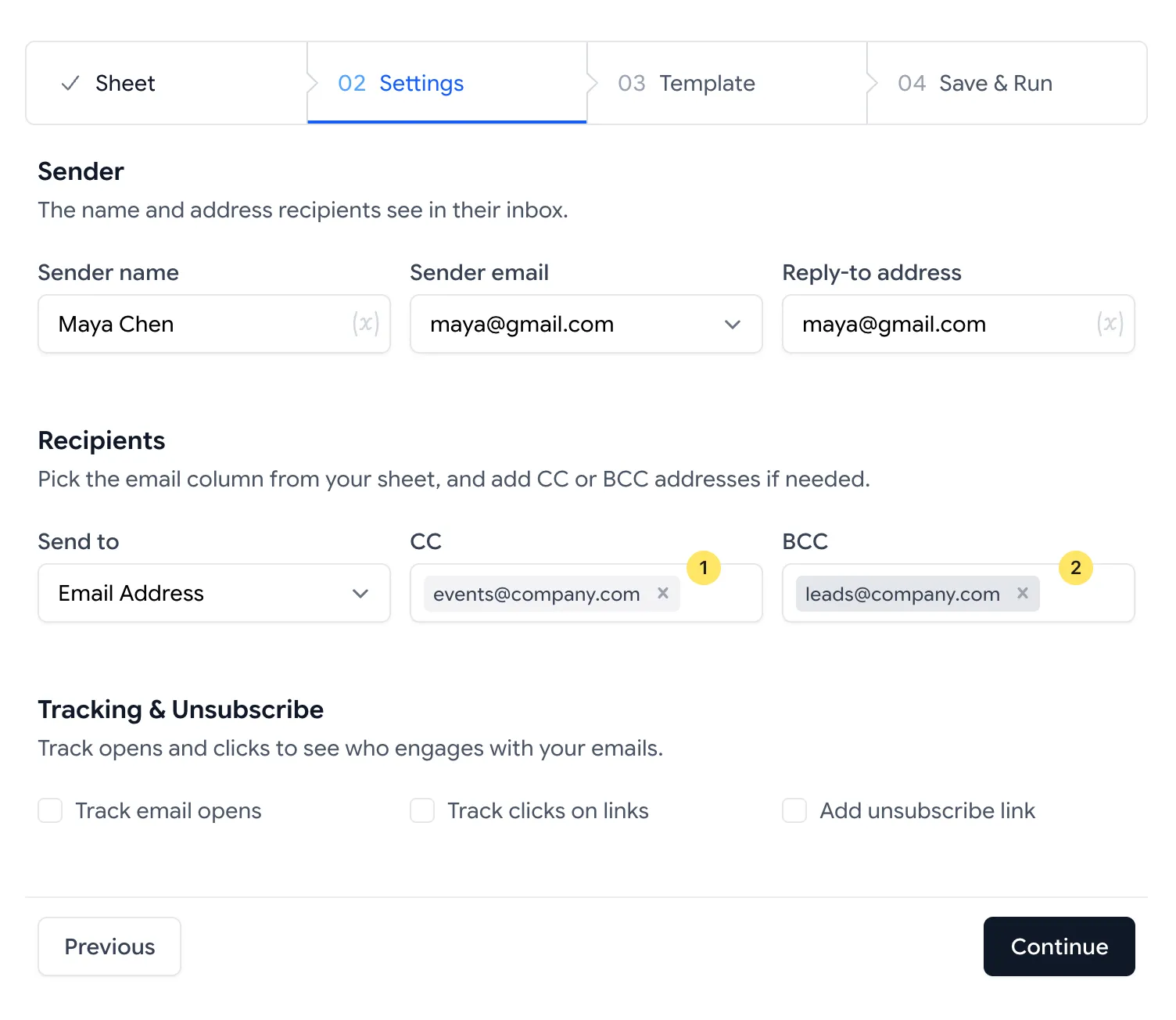
Addresses in CC (1) and BCC (2) are copied on every email in the campaign. -
Click Continue and finish the campaign as usual.
BCC is handy for CRMs that log the emails they receive. For example, BCC your Salesforce address and each email is saved to that contact’s activity history.
Copy different people for each row
Section titled “Copy different people for each row”With mail merge, you can also CC and BCC different people for each row in your sheet. Add a column titled CC, a column titled BCC, or both, to your sheet. Mail Merge finds them by their titles, so there’s nothing to set up in the add-on.
| First Name | Email Address | CC | BCC |
|---|---|---|---|
| Angus | angus@clientone.com | finance@clientone.com | |
| Daniel | daniel@clienttwo.com | ||
| Sofia | sofia@clientsix.com | ana@clientsix.com, luis@clientsix.com | priya@company.com |
Angus’s email copies his finance team. Daniel’s goes only to Daniel. Sofia’s copies two of her colleagues, and Priya gets a blind copy. Separate several addresses in one cell with commas. Leave a cell empty to copy nobody on that row.
Use both together
Section titled “Use both together”You can use the Settings fields and the sheet columns in the same campaign. The addresses in Settings go on every email, and each row adds its own.
Say Maya puts events@company.com in CC in Settings and uses the sheet above. Angus’s email is CC’d to events@company.com and finance@clientone.com. Daniel’s row has no CC, so his email is CC’d only to events@company.com.
Use CC and BCC from a Gmail draft
Section titled “Use CC and BCC from a Gmail draft”When your template is a Gmail draft that has CC or BCC addresses populated, Mail Merge copies them on every email, the same way as the fields in Settings. Nothing is replaced: each email gets the draft’s addresses, plus the ones in Settings, plus the ones in the row’s CC and BCC columns.
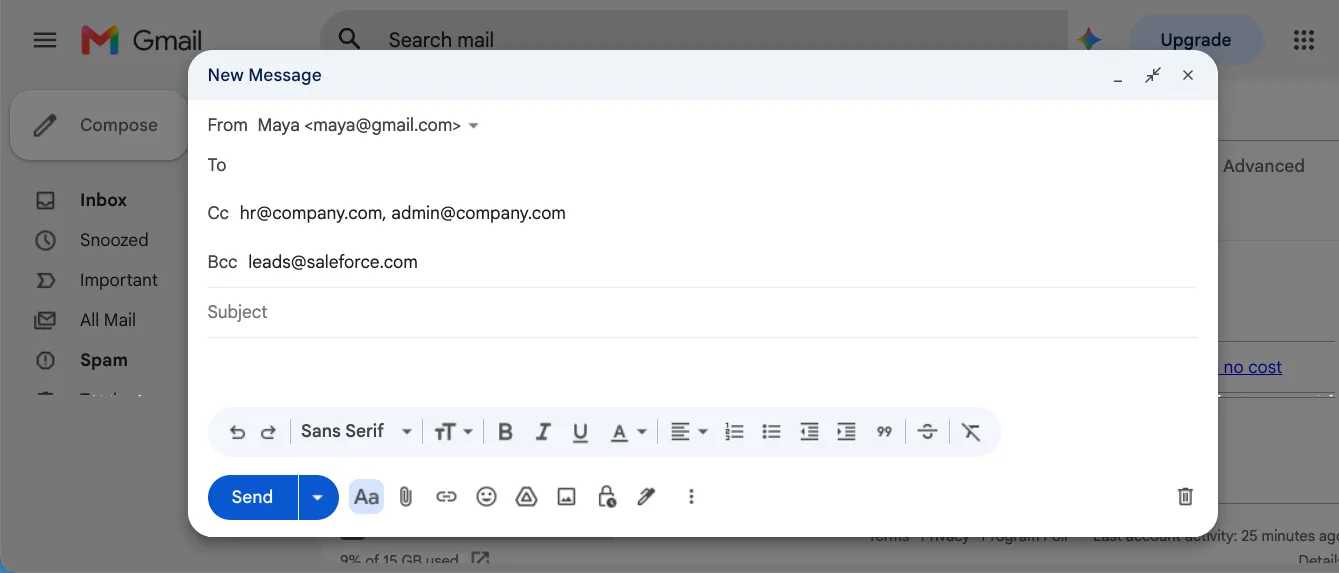
The same goes for the draft’s To field. Any address in it is added to every email, next to the row’s recipient. Leave To empty in the draft unless you really want that person on every email.
Things to know
Section titled “Things to know”- Each email needs an address in its Send to column. You can’t send a row with only CC or BCC addresses. The row is marked Invalid email and skipped.
- If an address in a CC or BCC cell isn’t valid, the row is marked Invalid email and skipped. Fix the address and clear the status cell to send it.
- Test emails go only to the address you type in the test form. CC and BCC are left out, so nobody gets copied on a test.
- If a CC or BCC recipient opens the email, it counts as an open for that row.