
What Permissions Does Mail Merge Need?
When you install or first open Mail Merge with Attachments, Google asks you to allow access to parts of your Google account. Mail Merge uses that access to read your recipient list, prepare personalized emails from your templates, attach files, and send messages from your Gmail account.
This page explains what each permission is used for and how the add-on handles your data. You can also read the full Digital Inspiration privacy policy.
Authorize Mail Merge
Section titled “Authorize Mail Merge”If you open Mail Merge from Google Sheets before authorizing it, Sheets asks for permission to run the add-on. Google then guides you through sign-in and account access.
-
If Sheets displays The add-on Mail Merge with Attachments needs your permission to run in this document, click OK to begin authorization.
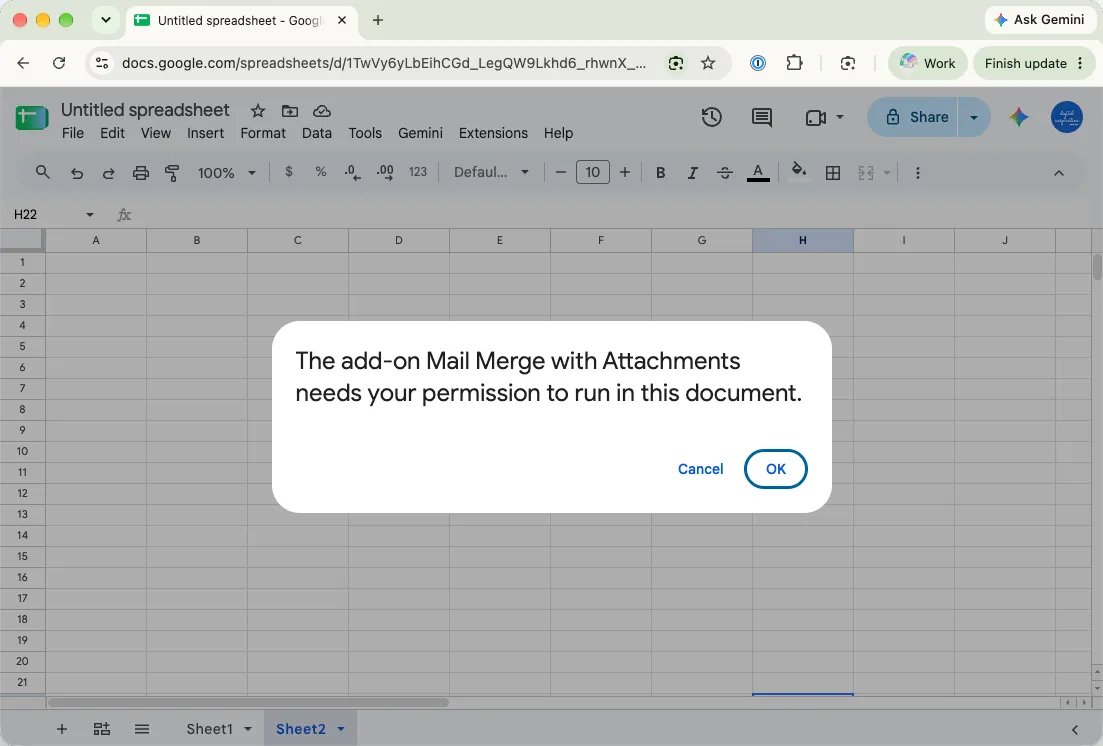
Click OK to begin authorizing Mail Merge from Google Sheets. -
Check the Google account shown on the sign-in screen. Use the account you want to send emails from, then click Continue. This screen also shows the email address Google shares with Mail Merge.
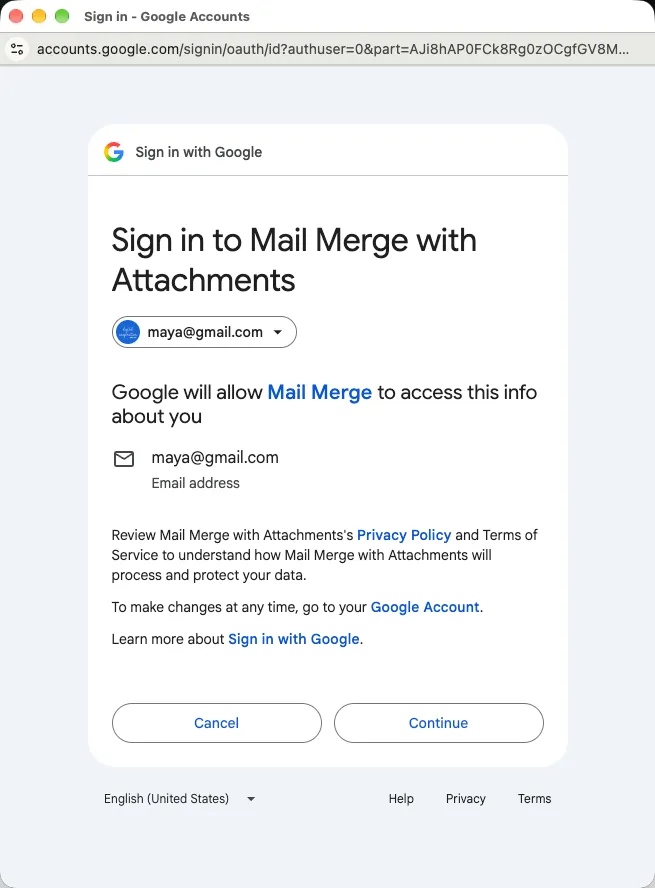
Check your sending account before you continue. -
Review the permissions on the next screen. Each checkbox represents access to a Google service or feature. Read the explanations below before granting access; See access details provides more information about each permission. You can use Select all to select the full set of permissions Mail Merge requests, then continue with Google’s authorization flow.
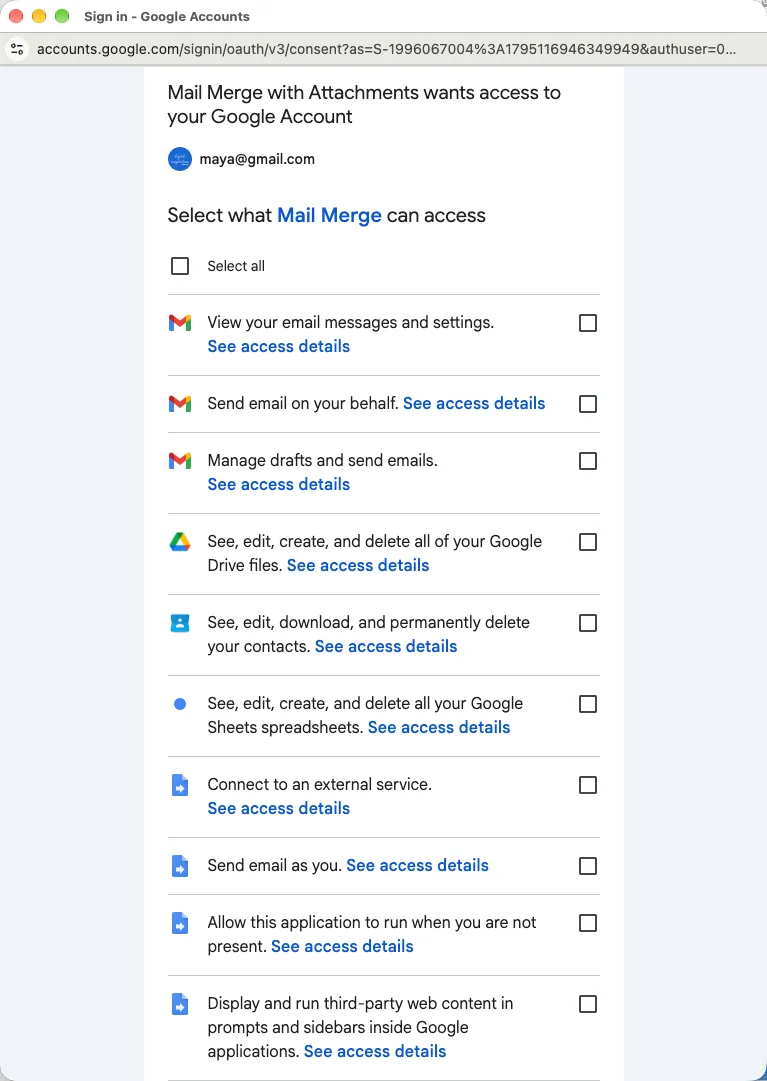
Review the requested access. Select all selects every permission listed on this screen.
If you leave some permissions unchecked
Section titled “If you leave some permissions unchecked”Google lets you approve individual permissions. If Mail Merge tries to use access you haven’t granted, the operation can stop with an authorization error or ask you to approve the missing permission. Some operations need several permissions together, so denying one can stop a whole merge.
The following features depend on each type of access. This list does not guarantee that the rest of the add-on will work with incomplete authorization.
- Gmail messages, settings, and drafts: Mail Merge needs this access to load Gmail draft templates, create drafts, and list your sending aliases. Missing required Gmail access can prevent campaign setup or sending.
- Sending email: Without the required sending access, Mail Merge cannot send test emails or campaign emails from your account. This also affects scheduled sends. Both Send email on your behalf and Send email as you relate to sending.
- Google Drive: Without Drive access, Mail Merge cannot retrieve Drive files for attachments or upload attachments from your computer to Drive. A merge that needs these files can fail.
- Google Contacts: Without Contacts access, Mail Merge cannot import recipients from Google Contacts. Recipients already in your spreadsheet are not deleted, but using them still requires the permissions needed to read the sheet and send emails.
- Google Sheets: Without Sheets access, Mail Merge cannot read your recipient list, personalization fields, or campaign configuration, so it cannot run a merge from that spreadsheet.
- External services: Without this access, license verification and connections to outside services can fail. This can affect premium activation and imports from services such as HubSpot or Mailchimp.
- Running when you are not present: Without background access, Mail Merge cannot set up the scheduler it uses to send emails while your sheet is closed. Scheduled sends also need the relevant Gmail, Sheets, and attachment permissions.
- Prompts and sidebars: Without this access, Mail Merge cannot display the interface you use to configure and run campaigns inside Google Sheets.
Scheduled jobs cannot display a permission prompt while running in the background. If a scheduled merge is missing required access, it can fail until you return to the add-on and authorize it. See Google’s explanation of partial authorization and background triggers.
Grant a missing permission
Section titled “Grant a missing permission”In the sending account, go to Extensions > Mail Merge with Attachments > Open Mail Merge and try the action again. If Google displays an authorization prompt, review and approve the missing access. To grant the full requested set, choose Select all on the consent screen and finish authorization.
If no prompt appears and you still get a permission error, remove Mail Merge’s account access, then open the add-on again to authorize it. Scheduled merges cannot run while their required access is removed. After authorizing, check the campaign’s Run in the background setting and its Mail Merge Status column before relying on future scheduled sends.
Mail Merge permissions explained
Section titled “Mail Merge permissions explained”The permission names on Google’s consent screen describe the access being granted. The sections below explain how Mail Merge uses that access.
View your email messages and settings
Section titled “View your email messages and settings”Mail Merge reads the Gmail draft you use as an email template. It also reads the list of sending aliases connected to your Gmail account, so you can choose which address to send from.
Send email on your behalf
Section titled “Send email on your behalf”Mail Merge sends personalized emails through your Gmail account. You can send from your primary Gmail address or an alias connected to that account. The permission labeled Send email as you is also used for sending your mail merge.
Manage drafts and send emails
Section titled “Manage drafts and send emails”Mail Merge can create Gmail drafts from templates and read the drafts you select for a merge. Draft access lets it use your message’s subject, formatting, and content when preparing personalized emails.
See, edit, create, and delete all of your Google Drive files
Section titled “See, edit, create, and delete all of your Google Drive files”Mail Merge reads files you choose from Google Drive to include as email attachments. If you upload an attachment from your computer, the add-on saves it to Google Drive before sending it. Mail Merge never deletes files from your Drive.
See, edit, download, and permanently delete your contacts
Section titled “See, edit, download, and permanently delete your contacts”You can import Google Contacts into your recipient spreadsheet. Mail Merge reads those contacts and writes them to the sheet. It never edits or deletes your Google Contacts.
See, edit, create, and delete all your Google Sheets spreadsheets
Section titled “See, edit, create, and delete all your Google Sheets spreadsheets”Your spreadsheet contains the recipient email addresses, personalization fields, and mail merge configuration. Mail Merge reads this information to prepare and send your emails.
Connect to an external service
Section titled “Connect to an external service”When you buy a Mail Merge subscription, the add-on connects to the payment processor’s API to verify your payment and activate the product. It also needs external connections to import contacts from services such as HubSpot or Mailchimp.
Allow this application to run when you are not present
Section titled “Allow this application to run when you are not present”Mail Merge uses a background scheduler on Google’s servers to send scheduled emails. Scheduled merges can run even when your spreadsheet is closed or your computer is turned off.
Display and run third-party web content in prompts and sidebars inside Google applications
Section titled “Display and run third-party web content in prompts and sidebars inside Google applications”This permission lets Mail Merge display its interface inside Google Sheets, where you configure and run your merges.
How Mail Merge uses your data
Section titled “How Mail Merge uses your data”Information collected and stored
Section titled “Information collected and stored”Mail Merge collects information only with your consent and only the minimum needed to operate the add-on. Your add-on settings are stored on Google servers in the Google Cloud project associated with Mail Merge. Mail Merge does not store your Google account data on non-Google servers.
Google sign-in provides information such as your email address. We use it to generate your user license, send payment receipts, and communicate about product updates.
Data safety
Section titled “Data safety”Mail Merge uses encryption to protect data in transit and at rest. Settings and data stored in the add-on’s Google Cloud project use Firestore, which encrypts data at rest. Operational logs are stored in Google Cloud Logging and used to monitor the app and investigate errors.
Our team does not read your email messages. If you need technical help, we may ask you to share your add-on settings with the developer for support.
Advertising and AI
Section titled “Advertising and AI”We do not use your data for market research, advertising, personalized content, retargeting, or recommendations. We do not use or retain data obtained through Google Workspace APIs to develop, improve, or train generalized AI or machine-learning models.
Sharing and payments
Section titled “Sharing and payments”We use access to Gmail to provide Mail Merge’s email features, as described above, and do not use that data for other purposes. We do not transfer or share your information unless necessary to provide and improve these features, comply with applicable law, or as part of a merger, acquisition, or sale of assets.
Payments are handled by third-party processors such as PayPal, Paddle, and Stripe. We do not store or have access to your credit card details.
Security audit
Section titled “Security audit”Mail Merge’s source code has been audited by security vendors appointed by Google. If your organization needs a copy of the audit certificate, contact our support team.
Remove access or request data deletion
Section titled “Remove access or request data deletion”You can stop using Mail Merge and remove its access to your Google account:
- In Google Sheets, go to Extensions > Add-ons > Manage add-ons. Find Mail Merge with Attachments, open its options menu, and choose Uninstall. See Google’s instructions for uninstalling add-ons.
- To review or remove account access directly, open your Google Account connections, select Mail Merge with Attachments, and review its access details. Follow Google’s instructions for removing an app’s access.
Removing access prevents Mail Merge from accessing your Google account, so it can no longer send scheduled merges using that access.
If your personal information changes, or you want to request deletion or deactivation of your information, contact our support team. We respond to these requests within 5 business days.